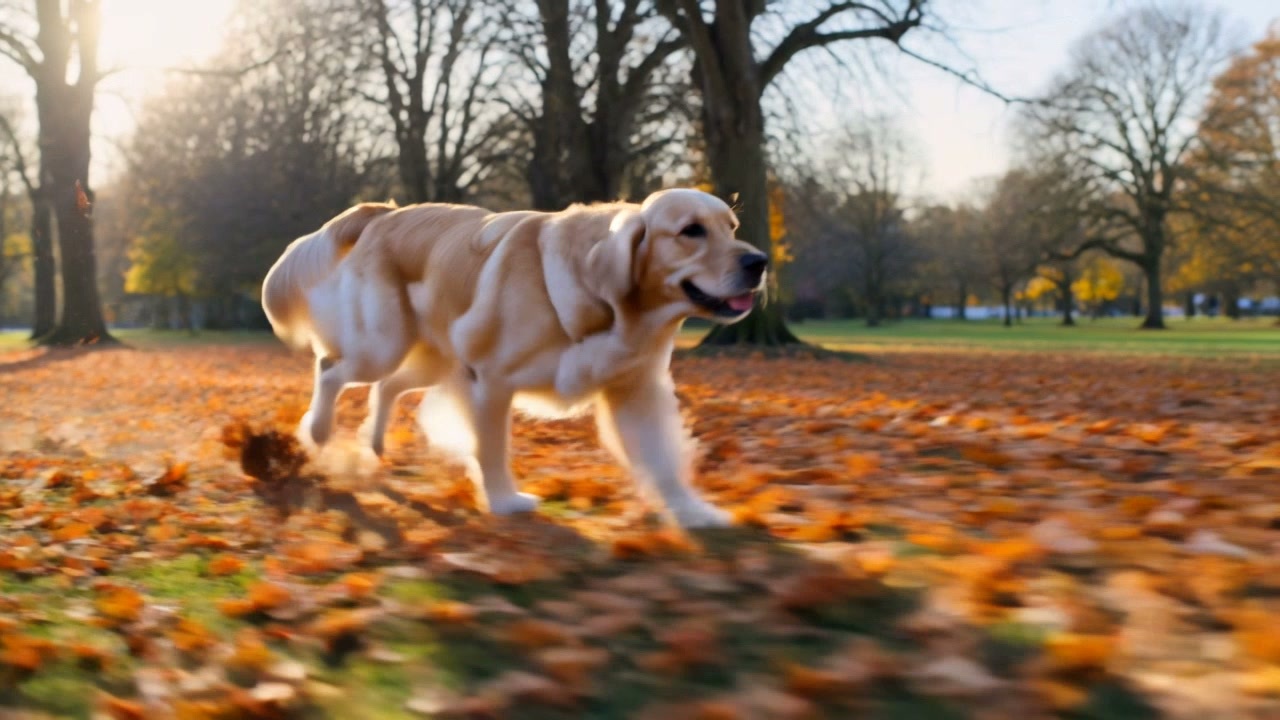
I don't review video models from press kits, so I spent $0.42 and generated a clip with Kling 3.0 myself: a golden retriever running through autumn leaves, 5 seconds, via fal's Standard text-to-video endpoint. The point of a "just dropped" review is to tell you what actually comes out — so here's what came out.
The good part is immediate. The lighting is real cinematography — low afternoon sun, rim-lit fur, soft depth-of-field falloff on the background trees. The leaves kick up with believable weight. Side by side with an open model like Pyramid Flow, it isn't close: Kling is doing film, the open models are doing footage.

And then there's the dog's front legs. Watch the run and the model does the thing every video model still does on fast quadruped motion — for a few frames the retriever has what looks like an extra leg, and the paws smear. It's the 2026 tell: stand still and it's photoreal; move fast and the anatomy negotiates with physics and loses. Honest verdict from one generation: stunning as a shot, not yet trustworthy as a take you'd ship without a re-roll.
Who it's for
Anyone who wants a cinematic clip today without a GPU or a pipeline — marketers, social creators, storyboarders. The hosted web app is a two-minute on-ramp, the API is one call, and at ~$0.42 a clip you can afford to re-roll until a shot lands. The native multi-language audio is a genuine differentiator if you need talking characters.
Who should skip it
If you need to own the model — run it offline, fine-tune it, keep your data on your own hardware — Kling is the wrong shape: it's hosted, paid, and closed. Go to Pyramid Flow or another open model and accept the quality trade. And if you need guaranteed, repeatable, artifact-free output for a paying client, budget for re-rolls and a human eye on every clip — no 2026 video model, this one included, is a one-shot machine yet.
I'm not putting a number on a single $0.42 generation — but as a first hands-on, Kling 3.0 is the most convincing text-to-video I've personally run.